
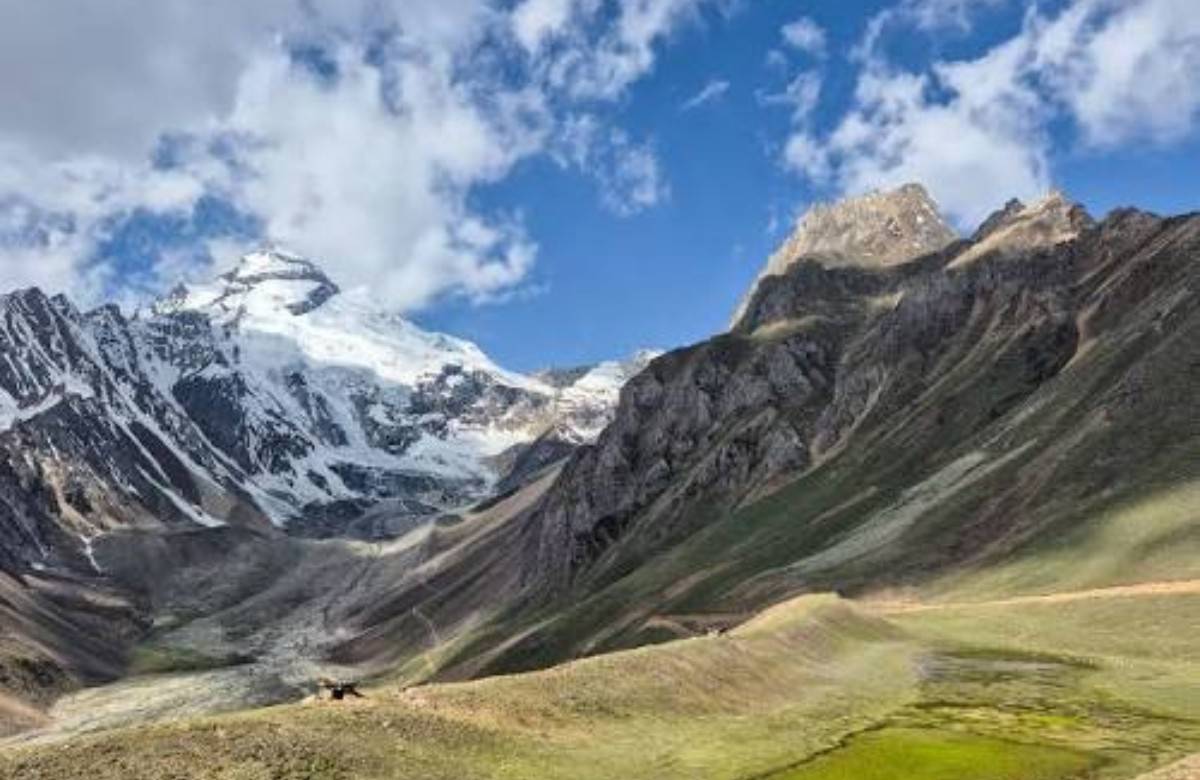
Most pilgrims spend days travelling to reach Adi Kailash — through Dharchula, through Gunji, through the Byans Valley — without a clear picture of what actually awaits them at the end of that journey. They hear about the sacred lake, about the Shiva-Parvati temple, about the reflection of the mountain on the water — but the reality of Jolingkong as a place, its altitude, its spiritual geography, and what you can actually do when you arrive there, is rarely explained in detail. This guide fills that gap. Jolingkong is the high-altitude basin at the foot of Adi Kailash where the yatra reaches its spiritual climax — and it deserves to be understood as fully as the journey that leads to it. Here is everything about Jolingkong: the altitude, the sacred lake, the temple, the short trek from the roadhead, the views, and why this small meadow basin at approximately 4,572 metres has drawn pilgrims across centuries.
What Is Gunji Village and Why Does It Matter?
Gunji is a small border village in the Dharchula tehsil of Pithoragarh district, Uttarakhand, situated at an elevation of approximately 3,200 metres. It lies near the trijunction point where India, Nepal, and China converge — making it one of the most geopolitically and spiritually significant villages in the country. The 2011 census recorded a population of just 335 residents across 194 households — a tiny settlement by any measure. But during the yatra season from May to September, Gunji transforms into a bustling pilgrimage hub, with groups of yatris, ITBP personnel, KMVN staff, local traders, mule owners, and porters filling the village with an energy that blends the practical with the sacred. Most critically, Gunji is the last sizable Indian settlement before the Indo-Tibetan border and the point where the motorable road forks into the two separate routes that lead to Adi Kailash and Om Parvat. Everything on the yatra flows through this village.
What Is Jolingkong and Why Does It Matter?
Gunji is a small border village in the Dharchula tehsil of Pithoragarh district, Uttarakhand, situated at an elevation of approximately 3,200 metres. It lies near the trijunction point where India, Nepal, and China converge — making it one of the most geopolitically and spiritually significant villages in the country. The 2011 census recorded a population of just 335 residents across 194 households — a tiny settlement by any measure. But during the yatra season from May to September, Gunji transforms into a bustling pilgrimage hub, with groups of yatris, ITBP personnel, KMVN staff, local traders, mule owners, and porters filling the village with an energy that blends the practical with the sacred. Most critically, Gunji is the last sizable Indian settlement before the Indo-Tibetan border and the point where the motorable road forks into the two separate routes that lead to Adi Kailash and Om Parvat. Everything on the yatra flows through this village.
Gunji: The Strategic Junction Where the Route Forks
This is the defining geographical fact about Gunji that every pilgrim must understand before arrival. At Gunji, the road divides into two separate branches, and your entire day-planning for the yatra is built around this fork.
| Location | Altitude (m) | Altitude (ft) |
| Dharchula | ~940 m | ~3,084 ft |
| Gunji Village | ~3,200 m | ~10,499 ft |
| Kuti Village | ~3,600 m | ~11,811 ft |
| Jolingkong | ~4,572 m | ~15,000 ft |
| Parvati Sarovar | ~4,501 m | ~14,764 ft |
| Gauri Kund | ~4,572 m | ~15,000 ft |
| Adi Kailash Peak | 5,945 m | 19,505 ft |
Note that even the base camp at Jolingkong — approximately 4,572 metres — is well above the threshold where altitude sickness is a genuine concern for most people. All pilgrims spending time at Jolingkong are in the altitude risk zone and should acclimatise properly at Gunji (3,200 m) before proceeding.
The Drive from Gunji to Jolingkong
The journey from Gunji to Jolingkong is approximately 30 to 45 km by the 4x4 off-road route, taking 2.5 to 4 hours depending on road conditions. This stretch of the yatra is itself a spectacle — the landscape transforms completely as you climb deeper into the Kuti Valley, leaving the forest gorges behind and entering a wide, austere alpine world of glacial streams, barren ridges, and sky-filling mountain faces.
Key Stops on the Gunji to Jolingkong Drive
- Nabi Village (Napalchu): A quiet Himalayan hamlet on the route; local Rung community homestays are available here as an alternative base to Gunji
- Rongkong Village: A tiny high-altitude settlement inhabited by Bhotiya communities; a brief stop reveals traditional mountain architecture and the warmth of border-region hospitality
- Kuti Village (approximately 3,600 m): The last inhabited settlement before Jolingkong, named in local tradition after Kunti — the mother of the Pandavas. Nearby are the ruins of Pandav Kila, a fort-like structure associated in local legend with the Pandavas' exile, and Bheem ki Kheti, agricultural terraces said to have been farmed by Bhima. These are meaningful stops for pilgrims interested in the Mahabharata geography of this region
- En route panoramic views: The drive offers dramatic views of Brahma Parvat (6,317 m), Ganesh Parvat (6,537 m), and the Parvati Mukut — a multi-spired peak visible from the road before Jolingkong
- Final approach to Jolingkong: The road opens into a wide, otherworldly basin and the pyramidal form of Adi Kailash comes into full view for the first time — a moment that pilgrims consistently describe as one of the most powerful of the entire yatra
The Trek from Jolingkong Road-Head to Parvati Sarovar
When pilgrims say 'Adi Kailash trek', the walk they are referring to is the short foot journey from the Jolingkong motorable road-head to Parvati Sarovar and the Shiva-Parvati Temple at the base of the mountain. Thanks to road improvements completed by the Border Roads Organisation (BRO), vehicles can now reach very close to the darshan points — meaning the actual walking distance is far shorter than older guides suggest.
The Short Trek: What to Expect
- Distance from Jolingkong road-head to Parvati Sarovar: approximately 2 to 4 km on foot, depending on the current road-end point in any given season
- Time required: approximately 1 to 2 hours at a comfortable pilgrimage pace
- The trail from the road-head is a cemented path after a yellow and green railing section — more accessible than the muddy trail of earlier years
- The path rises gently, passing the viewpoint for Parvati Mukut before opening to the lake shore
- Difficulty rating: Easy to Moderate — achievable by most adults in reasonable health at this altitude; altitude fatigue is the main challenge, not trail technicality
- Parvati Sarovar appears suddenly as you crest a gentle rise — a still, emerald-green glacial lake with Adi Kailash rising directly above it
Gauri Kund: The Further Sacred Pond
Beyond Parvati Sarovar, a further 2 km walk leads to Gauri Kund — a second sacred pond at the very base of Adi Kailash. Gauri Kund is associated with Goddess Parvati (also known as Gauri) and is considered a site of deep spiritual significance. Bathing is not permitted at Gauri Kund — pilgrims visit for darshan only. The views of Adi Kailash from Gauri Kund, with the mountain framed between ridges and reflected in the still water below, are consistently described as the finest viewpoint of the entire yatra.
Parvati Sarovar: The Sacred Heart of Jolingkong
Parvati Sarovar — also called Parvati Kund — is the sacred glacial lake that forms the spiritual centrepiece of the Jolingkong basin and the Adi Kailash darshan. It sits at approximately 4,501 metres, directly at the foot of Adi Kailash, and is one of the holiest bodies of water in the Kumaon Himalayan pilgrimage circuit.
Spiritual Significance of Parvati Sarovar
Hindu scriptures and local Kumaoni tradition describe Parvati Sarovar as the lake where Goddess Parvati bathed — an act of devotional purification that infused the waters with divine energy. Pilgrims who take a holy dip in the lake are believed to receive the blessings of both Lord Shiva and Goddess Parvati. The water is glacially cold year-round — this is not a symbolic gesture but a genuine physical act of devotion that leaves most pilgrims breathless, both from the cold and from the altitude.
The Parikrama of Parvati Sarovar
Many pilgrims perform a parikrama (circumambulation) of Parvati Sarovar as part of their Jolingkong darshan. The circuit around the lake is short — approximately 1 to 1.5 km — and is walked clockwise in the traditional Hindu direction. The parikrama is performed at the base of Adi Kailash, making it one of the most intimate acts of devotion available to any Shiva pilgrim who cannot undertake the far longer and more demanding parikrama of Mount Kailash in Tibet.
The Reflection of Adi Kailash in the Lake
On clear mornings — which typically means arriving early, before mid-morning when cloud often builds — the snow face of Adi Kailash reflects in the still surface of Parvati Sarovar. This reflection is considered by pilgrims to be a physical manifestation of the divine — the mountain's sacred presence appearing in the water below. The quality of this reflection, and the silence of the basin at that hour, is what almost every pilgrim names as the moment their yatra became something they will never forget.
The Shiva-Parvati Temple at Jolingkong
On the shore of Parvati Sarovar stands an ancient Shiva-Parvati temple — the ritual focal point of the Jolingkong darshan. The temple is modest in scale but profound in atmosphere. It sits directly against the backdrop of Adi Kailash, with the lake below and the mountain above, creating a visual and spiritual alignment that feels entirely intentional — as though the temple was placed exactly where the divine geometry of this valley demanded it to be. Pilgrims offer prayers here after taking the holy dip in Parvati Sarovar, completing the core ritual sequence of the Jolingkong darshan. The temple is maintained by local communities and is open during the yatra season from May to October. A resident pujari is typically present during peak season months to perform ceremonies for visiting pilgrims.
What Pilgrims Do at the Temple
- Offer prayers and perform aarti — typically at dawn and dusk, when the quality of light and silence is most powerful
- Seek blessings for personal intentions — the Jolingkong temple is considered as potent a site for petition and prayer as any major Shiva shrine in India
- Meditate in the vicinity of the lake and temple — many pilgrims spend hours simply sitting in the basin, absorbing the silence and the mountain's presence
- Perform the parikrama of Parvati Sarovar — clockwise circumambulation as an act of devotion to Goddess Parvati
Accommodation at Jolingkong
Jolingkong has basic accommodation available during the yatra season (approximately May to October). Expectations should be calibrated appropriately — this is a remote high-altitude meadow, not a developed tourist destination, and the facilities reflect that.
- Tented camps: The most common accommodation option at Jolingkong during the yatra season, operated by private tour operators and KMVN; basic bedding and shared facilities
- Eco huts or shelters: Fixed structures with beds available at the camp site; weather-dependent in terms of availability and access
- Meals: Basic vegetarian meals including dal, rice, rotis, and hot beverages are available at the camp kitchen during peak season months
- No electricity grid: Power is solar-dependent or generator-supplied; charge all devices fully in Gunji or Dharchula before arriving
- No mobile network: There is no mobile signal at Jolingkong — carry a satellite communicator if individual communication is essential
- Drinking water: Available from the camp; do not drink directly from the lake or streams without treatment
- Overnight stay: Spending a night at Jolingkong is strongly recommended — the pre-dawn and sunrise views of Adi Kailash from the basin are described by virtually every pilgrim who has seen them as the definitive moment of the yatra
Conclusion
Jolingkong is the destination that the Adi Kailash Yatra builds toward — every checkpoint, every altitude gain, every bend in the road through the Byans Valley — all of it leads to this meadow basin at 4,572 metres where Adi Kailash rises in silence above Parvati Sarovar. The combination of the sacred lake, the Shiva-Parvati temple on its shore, the reflection of the mountain in the water, and the extraordinary stillness of the high-altitude basin creates an experience that most pilgrims find impossible to fully describe when they return home. Some things in the Himalayas are beyond the language of travel writing. Jolingkong is one of them. Plan your acclimatisation carefully. Choose an operator with experience on this route. Arrive at Jolingkong early enough to spend real time there. And stay for sunrise.